Tuesday, 16 October 2012

Kepler Mission Planet Candidates, a Family Portrait


Using NASA's planet-hunting Kepler spacecraft, astronomers have discovered 2,326 candidate planets orbiting other suns since the Kepler mission's search for Earth-like worlds began in 2009. To find them, Kepler monitors a rich star field to identify planetary transits by the slight dimming of starlight caused by a planet crossing the face of its parent star. In this remarkable illustration, "Kepler's Planet Candidates," all of Kepler's planet candidates are shown in transit with their parent stars ordered by size from top left to bottom right. Simulated stellar disks and the silhouettes of transiting planets are all shown at the same relative scale, with saturated star colors. Of course, some stars show more than one planet in transit, but you may have to examine the picture at high resolution to spot them all. The star's color represents its temperature as shown in the lower scale, and the letter (A,F,G,K,M) are how astronomers classify star types. Look carefully: some systems have multiple planets. For reference, Jupiter is shown transiting the sun.

Credit: Jason Rowe, NASA Ames Research Center and SETI Institute

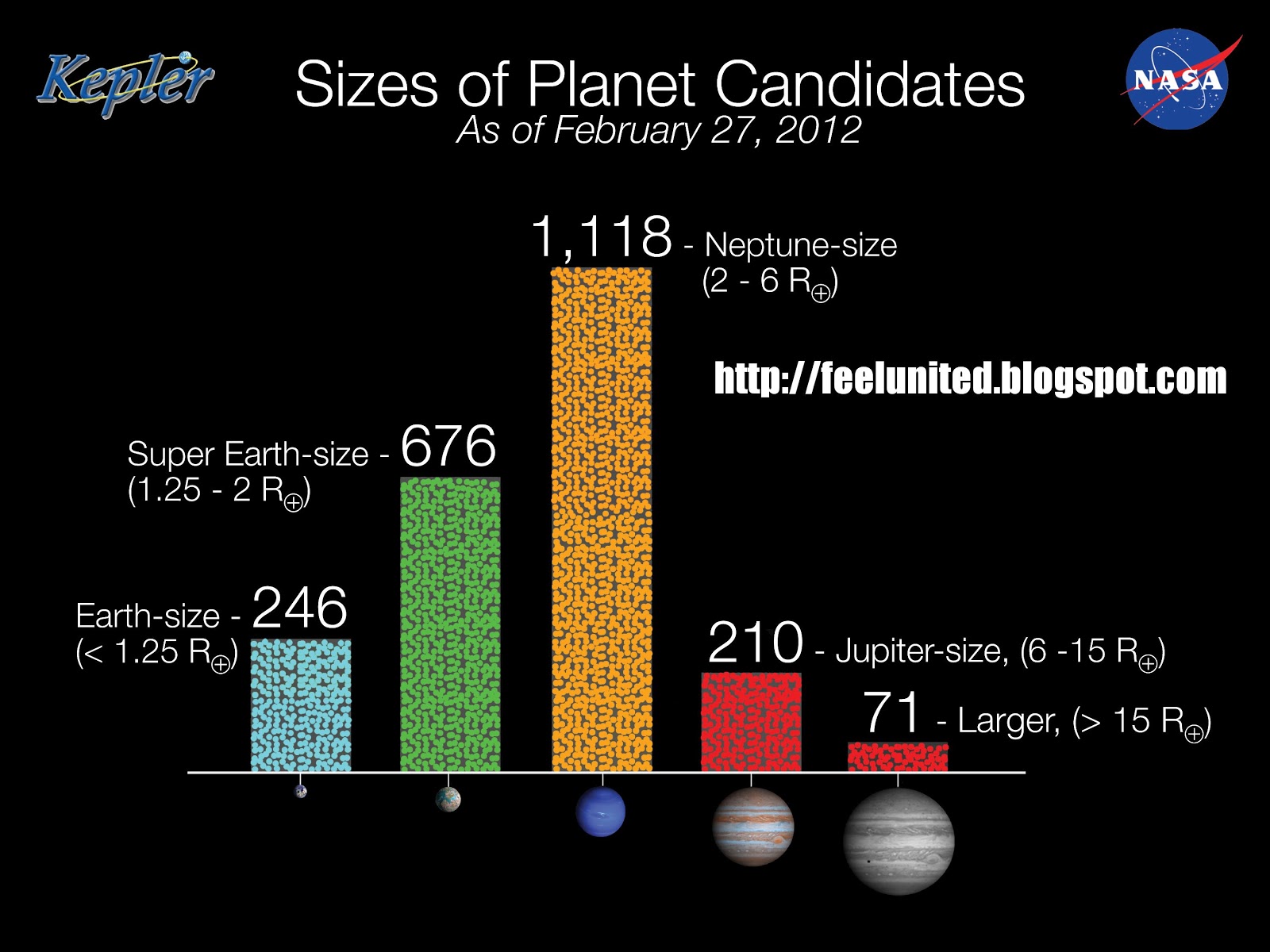
Kepler Planet Candidates by Size, Feb. 27, 2012


The histogram summarizes the findings in the Feb. 27, 2012 Kepler Planet Candidate catalog release. The catalog contains 2,321 planet candidates identified during the first 16 months of observation conducted May 2009 to September 2010. Of the 46 planet candidates found in the habitable zone, the region in the planetary system where liquid water could exist, ten of these candidates are near-Earth-size.

Amateur astronomers discover new planet with four suns

In this family portrait of the PH1 planetary system, the newly discovered planet is depicted in this artist's rendition transiting the larger of the two eclipsing stars it orbits. Off in the distance, well beyond the planet orbit, resides a sec (Haven Giguere/Yale)


Amateur astronomers have helped discover an alien planet with two suns and a twinkling twist: The entire twin-sun setup, a real-life version of Tatooine from "Star Wars," is orbited by two more stars — a solar system that is the first of its kind known.

The alien planet, called PH1, is a gas giant planet slightly bigger than Neptune. Its discovery in the midst of a strange, four-star planetary system is the first confirmed world discovered as part of the Yale University-led Planet Hunters project, in which armchair astronomers work with professional scientists to find evidence of new worlds in the bountiful data collected by NASA's Kepler space telescope.
"Planet Hunters is a symbiotic project, pairing the discovery power of the people with follow-up by a team of astronomers," said Debra Fischer, a professor of astronomy at Yale and planet expert who helped launch Planet Hunters in 2010, in a statement. "This unique system might have been entirely missed if not for the sharp eyes of the public."
Since its March 2009 launch, Kepler has found evidence of more than 2,300 candidate alien worlds. [Gallery: More Alien Planets with Twin Suns

Finding a strange, new world

Since its initial discovery via Planet Hunters, the existence of PH1 has been confirmed by a team of professional astronomers, who will present their work today (Oct. 15) at the annual meeting of the Division for Planetary Sciences of the American Astronomical Society in Reno, Nev.
With a radius about 6.2 times that of Earth's, PH1 is a smidge bigger than Neptune. The gassy planet spends 138 days completing a single orbit around its two parent stars, which have masses about 1.5 and 0.41 times that of the sun. The stars circle each other once every 20 days.
'It's a great honor to be a Planet Hunter, citizen scientist ... [and to] make a real contribution to science.' Robert Gagliano, Planet Hunter

The two other stars orbiting the PH1's twin suns are about 1,000 astronomical units (AU) from the parent stars. (One AU is about the distance between the Earth and sun, about 93 million miles or 150 million kilometers.)
If you're hoping to catch the quadruple sunset, this may not be your best bet. The researchers estimate PH1's temperature would range from a minimum of about 484 degrees Fahrenheit (524 Kelvin, or 251 degrees Celsius) and a maximum of 644 degrees F (613 Kelvin, or 340 degrees C), too hot to be in the habitable zone.
"Although PH1 is a gas giant planet, even if there is a possibility of rocky moons orbiting the body, their surfaces would be too hot for liquid water to exist," researcher Meg Schwamb of Yale University and colleagues write in a draft of their research article.

A planet with two suns

Until now, scientists had identified just six planets orbiting two parent stars, called circumbinary planets, and none of these have stellar companions orbiting them. Until their discovery, circumbinary planets were once the realm of science fiction with Tatooine, the fictional homeworld of Luke Skywalker in "Star Wars," among the most famous.
"Circumbinary planets are the extremes of planet formation," Schwamb said in a statement. "The discovery of these systems is forcing us to go back to the drawing board to understand how such planets can assemble and evolve in these dynamically challenging environments."
The Planet Hunter volunteers, Kian Jek of San Francisco, Calif., and Robert Gagliano of Cottonwood, Ariz., spotted PH1 using the transit method, noticing faint dips in light as the plant passed in front of, or transited, its parent stars.
Gagliano said he was "absolutely ecstatic" about the finding. "It's a great honor to be a Planet Hunter, citizen scientist, and work hand in hand with professional astronomers, making a real contribution to science," he said.
Jek, too, expressed his amazement.
"It still continues to astonish me how we can detect, let alone glean so much information, about another planet thousands of light-years away just by studying the light from its parent star," he said in a statement.
Schwamb led the team of professional astronomers who confirmed the discovery and characterized the planet, following observations from the Keck telescopes on Mauna Kea, Hawaii.
The research was supported by NASA and the National Science Foundation Astronomy and Astrophysics Postdoctoral Fellowship.

For more information on the Planet Hunters project, visit: http://www.planethunters.org

PH1 Amateur astronomers discover new planet with four suns

In this family portrait of the PH1 planetary system, the newly discovered planet is depicted in this artist's rendition transiting the larger of the two eclipsing stars it orbits. Off in the distance, well beyond the planet orbit, resides a sec (Haven Giguere/Yale)


Amateur astronomers have helped discover an alien planet with two suns and a twinkling twist: The entire twin-sun setup, a real-life version of Tatooine from "Star Wars," is orbited by two more stars — a solar system that is the first of its kind known.

The alien planet, called PH1, is a gas giant planet slightly bigger than Neptune. Its discovery in the midst of a strange, four-star planetary system is the first confirmed world discovered as part of the Yale University-led Planet Hunters project, in which armchair astronomers work with professional scientists to find evidence of new worlds in the bountiful data collected by NASA's Kepler space telescope.
"Planet Hunters is a symbiotic project, pairing the discovery power of the people with follow-up by a team of astronomers," said Debra Fischer, a professor of astronomy at Yale and planet expert who helped launch Planet Hunters in 2010, in a statement. "This unique system might have been entirely missed if not for the sharp eyes of the public."
Since its March 2009 launch, Kepler has found evidence of more than 2,300 candidate alien worlds. [Gallery: More Alien Planets with Twin Suns

Finding a strange, new world

Since its initial discovery via Planet Hunters, the existence of PH1 has been confirmed by a team of professional astronomers, who will present their work today (Oct. 15) at the annual meeting of the Division for Planetary Sciences of the American Astronomical Society in Reno, Nev.
With a radius about 6.2 times that of Earth's, PH1 is a smidge bigger than Neptune. The gassy planet spends 138 days completing a single orbit around its two parent stars, which have masses about 1.5 and 0.41 times that of the sun. The stars circle each other once every 20 days.
'It's a great honor to be a Planet Hunter, citizen scientist ... [and to] make a real contribution to science.' Robert Gagliano, Planet Hunter

The two other stars orbiting the PH1's twin suns are about 1,000 astronomical units (AU) from the parent stars. (One AU is about the distance between the Earth and sun, about 93 million miles or 150 million kilometers.)
If you're hoping to catch the quadruple sunset, this may not be your best bet. The researchers estimate PH1's temperature would range from a minimum of about 484 degrees Fahrenheit (524 Kelvin, or 251 degrees Celsius) and a maximum of 644 degrees F (613 Kelvin, or 340 degrees C), too hot to be in the habitable zone.
"Although PH1 is a gas giant planet, even if there is a possibility of rocky moons orbiting the body, their surfaces would be too hot for liquid water to exist," researcher Meg Schwamb of Yale University and colleagues write in a draft of their research article.

A planet with two suns

Until now, scientists had identified just six planets orbiting two parent stars, called circumbinary planets, and none of these have stellar companions orbiting them. Until their discovery, circumbinary planets were once the realm of science fiction with Tatooine, the fictional homeworld of Luke Skywalker in "Star Wars," among the most famous.
"Circumbinary planets are the extremes of planet formation," Schwamb said in a statement. "The discovery of these systems is forcing us to go back to the drawing board to understand how such planets can assemble and evolve in these dynamically challenging environments."
The Planet Hunter volunteers, Kian Jek of San Francisco, Calif., and Robert Gagliano of Cottonwood, Ariz., spotted PH1 using the transit method, noticing faint dips in light as the plant passed in front of, or transited, its parent stars.
Gagliano said he was "absolutely ecstatic" about the finding. "It's a great honor to be a Planet Hunter, citizen scientist, and work hand in hand with professional astronomers, making a real contribution to science," he said.
Jek, too, expressed his amazement.
"It still continues to astonish me how we can detect, let alone glean so much information, about another planet thousands of light-years away just by studying the light from its parent star," he said in a statement.
Schwamb led the team of professional astronomers who confirmed the discovery and characterized the planet, following observations from the Keck telescopes on Mauna Kea, Hawaii.
The research was supported by NASA and the National Science Foundation Astronomy and Astrophysics Postdoctoral Fellowship.

For more information on the Planet Hunters project, visit: http://www.planethunters.org
Four Star Planet PH1 Discovered


Four Star Planet

An artist's illustration of PH1, a planet discovered by volunteers from the Planet Hunters citizen science project. PH1, shown in the foreground, is the first reported case of a planet orbiting a double-star that, in turn, is orbited by a second distant pair of stars. The phenomenon is called a circumbinary planet in a four-star system.

A bit larger than Neptune and thought to be a gas giant, PH1 orbits its host stars every 137 days. Beyond the planet's orbit approximately 900 times the distance between the sun and Earth, a second pair of stars orbits the planetary system.

Main Article : Nasa

Monday, 10 September 2012

Sheen Chaudhry and Zara Akbar Celebriting Eid with Friends


Sheen Chaudhry and Zara Akbar Celebriting Eid with Friends


Saturday, 8 September 2012

Pakistani Sunny Leone Look Alike Fiza Ali


Fashion model Fiza Ali is not only a perfect figure to walk on ramp, but she has also proved herself in various T.V dramas. Fashion model Fiza Ali tremendously showed her acting skills too, besides her modeling guts; she was also nominated as the best T.V actress in PTV awards.

Pakistani Fashion and Showbiz industry is occupied with talented and smart figures. One of the Pakistani cutest Fashion model & drama actresses, Fiza Ali is moving progressively on the road of success.

Fashion model Fiza Ali is a heighted & smart figured young lady with the cute looks. One of the reasons of the smartness of Fashion model Fiza Ali is her habit of drinking lots of water; she also likes milk and vegetables as well. Fashion model Fiza Ali started her career from Karachi, but then she moved to Lahore to establish her Fashion career more enormously. Fashion model Fiza Ali is not only a perfect figure to walk on ramp, but she has also proved herself in various T.V dramas. Fashion model Fiza Ali tremendously showed her acting skills too, besides her modeling guts; she was also nominated as the best T.V actress in PTV awards. Now she is spending a happily married life with her husband, Fawad Farooque; the most considerable person of her life.

Fashion model Fiza Ali is a hot girl but with the cool nature and lovely smile, she has an ability to achieve her goals.